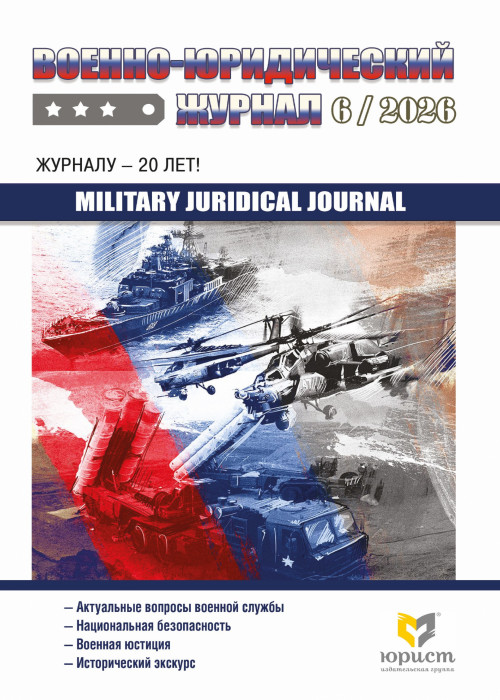
Published Date: 17.12.2026

Organizational and Legal Mechanism of National Security in the Context of Hybrid Challenges: Collisions of Strategic Planning and Instruments of Public Administration

Annotation

The article analyzes the functioning of organizational and legal instruments for ensuring the national security of the Russian Federation in the context of multifactorial challenges, with a focus on the military-legal sphere. The empirical base is formed by the National Security Strategies, the Military Doctrine, and Decree of the President of the Russian Federation No. 858 of November 25, 2025. Structural imbalances are revealed: conceptual ambiguity of the categorical apparatus, fragmentation of interdepartmental interaction, and a gap between value guidelines and legal mechanisms. Additionally, conflicts between the 2021 Strategy and military legislation are analyzed, and amendments to the Federal Law “On Defense” and the Federal Law “On the Status of Servicemen” are proposed. The author's definition of military security taking into account hybrid threats is presented. Based on the results of the study, the directions of modernization are substantiated: unification of legislation, implementation of strategic priorities into sectoral acts, digitalization of management procedures. The conclusion on the expediency of the transition to coordinated models of public administration is substantiated.


Library

1. Гусаим И.В. Философско-правовая трактовка дефиниций «Государственная безопасность», «Общественная безопасность» и «Национальная безопасность» / И.В. Гусаим // Юридическая наука. 2025. № 10. С. 8–14.
2. Кожевников О.А. Национальная безопасность: некоторые вопросы содержания и правового регулирования / О.А. Кожевников // Алтайский юридический вестник. 2025. № 3 (51). С. 89–93.
3. Марченко М.Н. Формирование правовой культуры населения в условиях интеграции новых регионов / М.Н. Марченко, С.А. Комаров // Юридическое образование и наука. 2024. № 6. С. 52–59.
4. Прохожев А.А. Трансформация правосознания населения на новых территориях Российской Федерации / А.А. Прохожев, В.В. Калмыков // Правовая политика и правовая жизнь. 2024. № 3. С. 72–84.
5. Радько Т.Н. Правовое просвещение в условиях цифровой трансформации и геополитической нестабильности / Т.Н. Радько, Е.А. Фролова // Государство и право. 2025. № 2. С. 31–42.
6. Сагирян И.Г. Эволюция концепта «национальная безопасность» в трех редакциях стратегии национальной безопасности Российской Федерации / И.Г. Сагирян, А.С. Петренко // Правовой порядок и правовые ценности. 2025. Т. 3. № 1. С. 34–45.
7. Тихалева Е.Ю. Государственная и общественная безопасность как стратегические национальные приоритеты: современное состояние / Е.Ю. Тихалева // Вестник Сургутского государственного университета. 2024. Т. 12. № 4. С. 143–154.
8. Юсупов Р.Г. Соотношение понятий «национальная безопасность» и «государственная безопасность» в праве. Место ФСБ России в обеспечении государственной безопасности / Р.Г. Юсупов, Т.А. Тимербулатов // Правовое государство: теория и практика. 2025. № 2 (80).
9. Dyzenhaus, D. The Rule of Law Project / D. Dyzenhaus // Harvard Law Review. 2016. Vol. 129. P. 1566–1617.
10. Lippmann, W. U.S. Foreign Policy / W. Lippmann. Boston : Little, Brown and Company, 1943. 177 p.
11. Ullman, R. Redefining Security / R. Ullman // International Security. 1983. Vol. 8. Iss. 1. P. 129–153.
12. Wolfers, A. National Security as an Ambiguous Symbol / A. Wolfers // Political Science Quarterly. 1952. Vol. 67. Iss. 4. P. 481–502.

Other articles