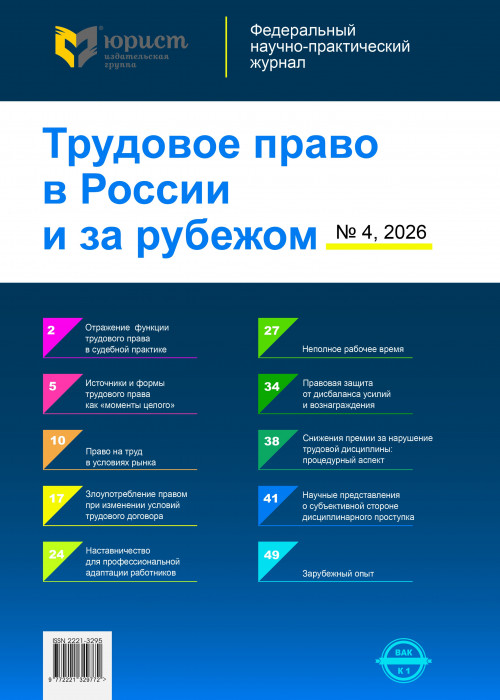
Legal Protection of Employees from Imbalances of Effort and Reward in Labor Relations
Annotation
This article examines the effort–reward imbalance (Siegrist’s model) as a key factor in the development of an adverse psychosocial work environment. The gap between employees’ substantial physical, emotional, and cognitive efforts and adequate rewards undermines job satisfaction and threatens their health. To mitigate this imbalance, it is essential to strengthen wage guarantees, including for work performed beyond established working hours, and to simplify the evidentiary procedure for proving overtime work. Concurrently, regulatory provisions governing employee recognition and career advancement require further refinement. The comprehensive implementation of these measures will contribute to improving the quality of working life for employees.
Keywords
| Type | Article |
| Information | Labor Law in Russia and Abroad № 04/2026 |
| Pages | 34-37 |
| DOI | 10.18572/2221-3295-2026-4-34-37 |