Published Date: 03.09.2026

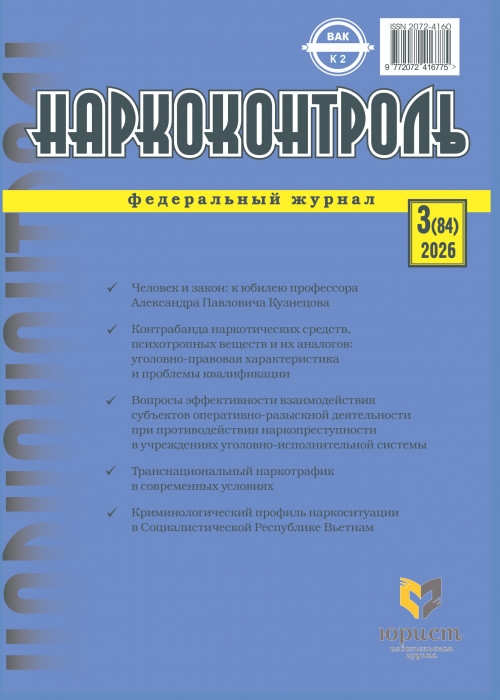
Criminological Profile of the Drug Situation in the Socialist Republic of Vietnam

Annotation

Purpose: to describe the drug situation in the Socialist Republic of Vietnam, revealing the determinants of crime, related phenomena and new approaches to combating it. Methodology: The study is based on content analysis of authentic documents, special legal methods (interpretation of laws and court decisions, formal legal methods), as well as historical methods. Conclusions based on the results of the conducted research: The Socialist Republic of Viet Nam is both a transit and distribution point for narcotic drugs, psychotropic substances, and their precursors (hereinafter referred to as drugs), especially synthetic types. Young people are a particularly vulnerable social group. A stable domestic drug market has developed due to historical factors (including an open-door policy), cultural features, accessibility of infrastructure, corruption in certain government agencies, the existence of stable supply networks, inter alia cross-border ones, high levels of organized crime, poverty, low levels of resocialization, isolation and the introduction of information technologies. The analyzed judicial practice indicates problems in the classification of drug crimes and the distinction between drug-related offenses. Nevertheless, steps are being taken to improve legislation in the field of combating drug trafficking. Scientific and practical significance: the systematization of foreign experience contributes to a comprehensive understanding of the problem for the implementation of effective international cooperation in the fight against drug crime.


Library

1. Дэвидсон Ф. Война во Вьетнаме 1946–1975 / Ф. Дэвидсон. Москва : Изографус : Эксмо, 2002. 816 c.
2. Ибрагимова З.Ф. Неравенство и бедность населения Вьетнама: тенденции и основные черты / З.Ф. Ибрагимова, Т.Ш.Л. Нгуен // Вестник Российского университета кооперации. 2016. № 3 (25). С. 40–44.
3. Ильин В.Е. Опыт Вьетнама по борьбе с наркотиками / В.Е. Ильин // Ойкумена. Регионоведческие исследования. 2020. № 1 (52). С. 112–122.
4. Мазырин В.М. Экономика Вьетнама в 2023 г. Плоды развития в неолиберальной парадигме / В.М. Мазырин // Юго-Восточная Азия: актуальные проблемы развития. 2023. Т. 4. № 3 (60). С. 110–123.
5. Минина Ю.Д. Традиция чернения зубов и жевания бетеля во Вьетнаме: история, смыслы, символика / Ю.Д. Минина // Юго-Восточная Азия: актуальные проблемы развития. 2016. № 33. С. 152–180.
6. Соболева Е.С. Бетель в Южной и Юго-Восточной Азии / Е.С. Соболева // Феномен удовольствия в культуре : материалы Международного научного форума (Санкт-Петербург, 6–9 апреля 2004 г.) Санкт-Петербург : Центр изучения культуры, 2004. С. 189–192.
7. Хуан В.К. Современные тенденции и основные направления организованной преступности во Вьетнаме / В.К. Хуан, Ф.Н. Хай // Журнал зарубежного законодательства и сравнительного правоведения. 2014. № 2. C. 339–346.
8. Хунг З.С. Основные причины роста наркопреступности во Вьетнаме / З.С. Хунг // Государственная служба и кадры. 2019. № 3. С. 125–127.
9. Чуен Н.В. Некоторые особенности организованной преступности во Вьетнаме / Н.В. Чуен, В.К. Хуан // Всероссийский криминологический журнал. 2014. № 1. С. 118–124.
10. Gao, H. Drug abuse and drug trafficking in Asia. In Handbook of Asian criminology / H. Gao // Liu J. Handbook of Asian Criminology / ed. by J. Liu, B. Hebenton, S. Jou. Springer : New York, 2013. P. 115–127
11. Tran, M.T.N. Understanding Vietnam’s drug policy for amphetamine-type stimulants misuse / M.T.N. Tran, M.P. Dunne, Le G. Minh, H.D. Han, T.T. Nguyen, H.T. Luong, Q.H. Luong, H.N. Pham, P. Baker // Harm Reduction Journal. 2022. № 19 (45). DOI: 10.1186/s129

Other articles