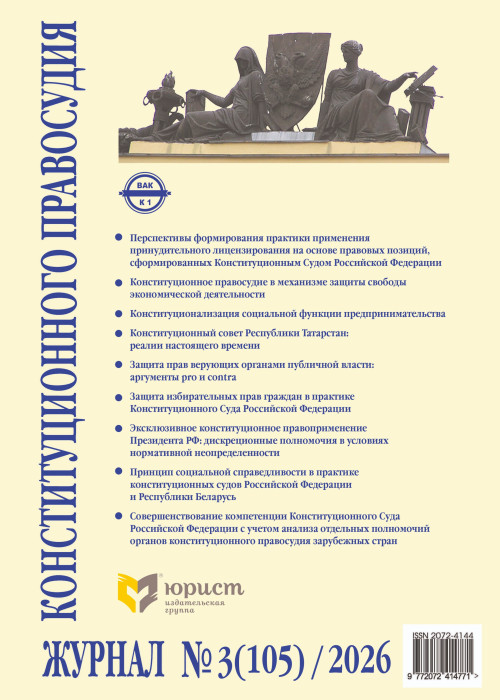
Exclusive Constitutional Law Enforcement of the President of the Russian Federation: Discretionary Powers in Conditions of Normative Uncertainty
Annotation
The article analyzes the discretionary powers of the President of the Russian Federation exercised in situations of normative uncertainty. It substantiates that the head of state’s activities in such conditions do not fit into the classical models of law enforcement (direct, derivative, interpretive) and require the identification of an independent type — exclusive constitutional law enforcement. Based on the analysis of the 2020 constitutional reform, the events of 1993, and the practice of creating federal districts, the essential features of this phenomenon are highlighted: special subject, normative uncertainty, reliance on the status of guarantor, discretionary nature, subsequent legitimation, syncretism of law enforcement and law-making. The author’s definition of exclusive constitutional law enforcement is formulated. Its limits are substantiated: constitutional principles, target orientation, and the need for subsequent legitimation. It is concluded that exclusive constitutional law enforcement is a natural tool for the evolutionary adaptation of the constitutional order.
Keywords
| Type | Article |
| Information | Journal of Constitutional Justice № 03/2026 |
| Pages | 34-37 |
| DOI | 10.18572/2072-4144-2026-3-34-37 |