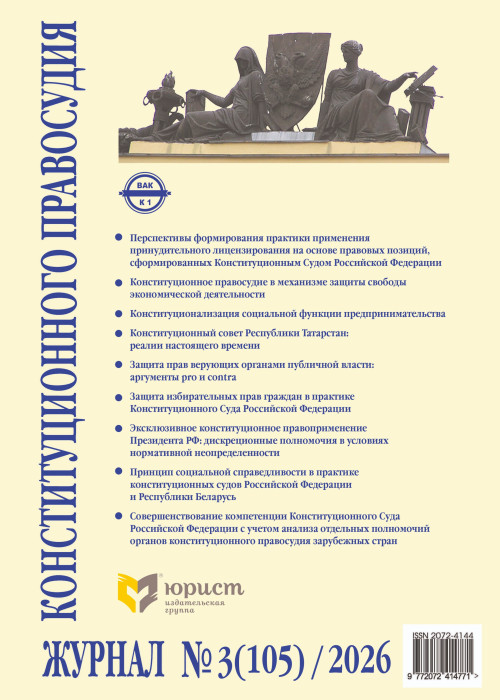
Prospects for the Development of Compulsory Licensing Practices Based on the Legal Positions Formulated by the Constitutional Court of the Russian Federation. Part 1
Annotation
The article provides a comprehensive analysis of the role of the Constitutional Court of the Russian Federation in formation legal approaches to the implementation and limitation of intellectual property rights, and examines current trends in the regulation of patent law. Intellectual property is viewed not as an absolute value, but as a social function that requires a balance between the interests of patent holders and society. The author provides examples of legislative changes in several countries (China, India, Brazil, South Africa, the UK, Belgium, and others) aimed at preventing abuses of patent rights and promoting innovation. In Judgement No. 13‑P of 12 March 2026, the Constitutional Court of the Russian Federation recognized as constitutional the Article 1362 (item 1) of the Civil Code of the Russian Federation and provided a detailed interpretation of the possibilities and features of its application, including taking into account the public interest in the availability of vital goods (for example, medicinal drugs) on the Russian market. According to the Court’s position, the institution of compulsory licensing is of an exceptional nature and requires a balanced approach to its application in order to preserve the patent protection system and the reputation of the Russian jurisdiction. This interpretation is consistent with international norms and lays the foundation for its balanced application in the Russian Federation, taking into account both the protection of intellectual property rights and the public interests, including the protection of citizens’ life and health.
Keywords
| Type | Article |
| Information | Journal of Constitutional Justice № 03/2026 |
| Pages | 1-11 |
| DOI | 10.18572/2072-4144-2026-3-1-11 |