Published Date: 10.06.2026

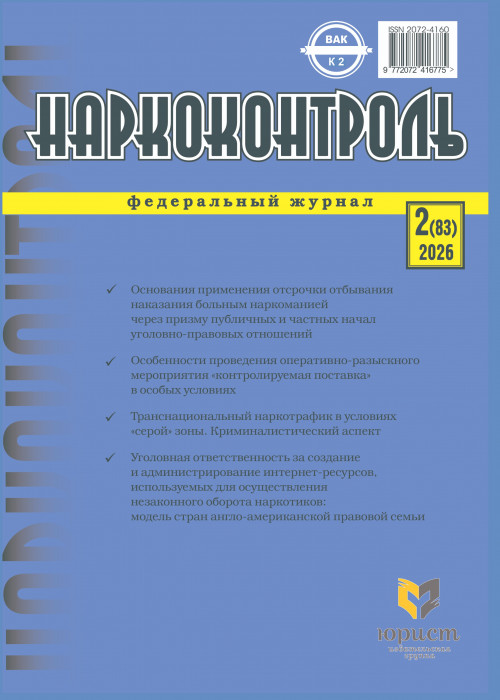
Criminal Liability for the Creation and Administration of Internet Resources Used for Drug Trafficking: A Model of Countries of the Anglo-American Legal Family

Annotation

Purpose: to outline the approaches of countries of the Anglo-American legal family (the United States of America, the United Kingdom of Great Britain and Northern Ireland, and the Commonwealth of Australia) to criminalizing the website creation and administration for criminal purposes, including drug trafficking, as well as the effectiveness of criminal prosecution based on case practice. Methods of research: the study is based on content analysis of authentic documents, special-legal methods (interpretation and formal-legal method) and consider comparative in nature. Conclusions based on the results of the conducted research: In countries of the Anglo-American legal system, general criminal law is applied, but there are some unique features: in the United States, it is classified as a federal crime and is considered continuing criminal enterprise; in the United Kingdom, it can be considered the distribution of illegal content. The perpetrator can be either an individual or a legal entity. The United States is the primary initiator of international cooperation and seeks to prosecute criminals within its own country. Scientific and practical significance: the prosecution of the website creation and administration for criminal purposes in foreign countries allows assessing the prospects for international cooperation in the fight against drug and cybercrime and elaborating existing gaps in studying foreign experience in this area.


Library

1. Сидоренко Э.Л. Незаконный оборот наркотических средств с использованием криптовалюты / Э.Л. Сидоренко // Противодействие криптовалютным преступлениям в зарубежных странах : учебное пособие / под редакцией А.Г. Волеводза. Москва : Юрлитинформ, 2025. С. 342
2. Bahamazava, K. The shift of DarkNet illegal drug trade preferences in cryptocurrency: The question of traceability and deterrence / K. Bahamazava, R. Nanda // Forensic Science International: Digital Investigation. 2022. Iss. 40. Art. 301377.
3. Basheer, R. Cryptomarkets’ Phenomenon: A Conceptualization Approach // Human Behavior and Emerging Technologies. 2022. Vol. 2022. Iss. 3. Art. 6314913. DOI: 10.1155/2022/6314913.
4. Craciunescu, N. Cultural Politics, Reciprocal Relations, and Operational Agility in Online Drug Markets / N. Craciunescu, N. South // Digital Transformations of Illicit Drug Markets: Reconfiguration and Continuity / eds. by M. Tzanetakis, N. South. Emeral
5. Espinosa, R. Scamming and the reputation of drug dealers on Darknet Markets / R. Espinosa // International Journal of Industrial Organization. 2019. Iss. 67. Art. 102523.
6. Norbutas, L. Reputation transferability across contexts: Maintaining cooperation among anonymous cryptomarket actors when moving between markets / L. Norbutas, S. Ruiter, R. Corten // International Journal of Drug Policy. 2020. Iss. 76. Art. 102635.
7. Online and offline determinants of drug trafficking across countries via cryptomarkets / L. Giommoni, D. Décary-Hétu, G. Berlusconi, A. Bergeron // Crime Law Soc Change. 2024. Iss. 81. P. 1–25.
8. Trust intermediary in a cryptomarket for illegal drugs / F. Andrei, D. Barrera, K. Krakowski, E. Sulis // European Sociological Review. 2024. Vol. 40. Iss. 1. P. 160–172. DOI: 10.1093/esr/jcad020.
9. Warren, I.J. Drugs and the Dark Web: The Americanisation of Policing and Online Criminal Law From an Australian Perspective / I.J. Warren, Е. Ryan // Digital Transformations of Illicit Drug Markets: Reconfiguration and Continuity / eds. by M. Tzanetakis,

Other articles