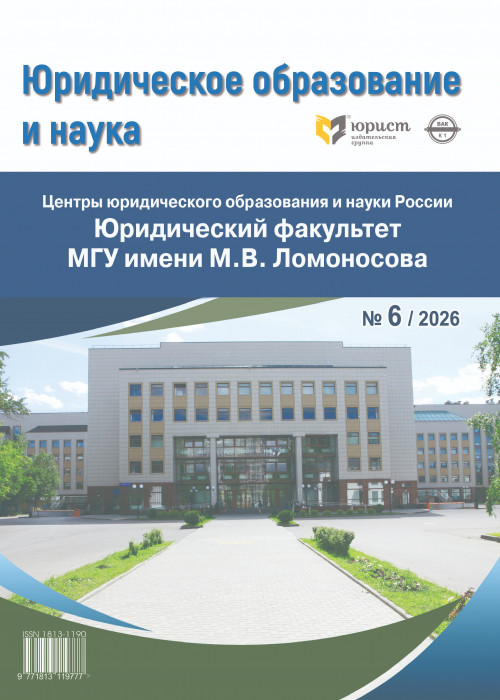
Department of Theory of State and Law at Moscow University
Annotation
Purpose. The primary objective of higher legal education is to develop professional legal awareness. Fundamental jurisprudence, including the theory of state and law, the philosophy of law, the history of political and legal doctrines, and the sociology of law, are aimed at achieving this goal. By their very nature, these disciplines foster the development of students' systemic critical thinking and enable them to formulate independent, well-founded proposals for improving legislation and/or law enforcement practices based on assessments of doctrinal political and legal ideas, extensive legal experience, and the interaction of legal cultures (traditions). Methodology: analysis and synthesis, hermeneutic and comparative approaches. Conclusions. It is argued that theoretical legal sciences in Russia have addressed various issues at different stages of our nation's history. Currently, these disciplines help law school graduates develop skills in consciously comparing legal phenomena (norms, institutions, approaches to solving social and legal problems, and customary normative and law enforcement practices) and evaluating them based on their independent comparative knowledge. Scientific and practical significance. This article retrospectively examines the Department of Theory of State and Law's contribution to the development of legal scholarship and the system of higher legal education. It substantiates the value of theoretical and legal research at various stages of our society's development. It demonstrates that high-quality theoretical generalization is impossible without methodologically sound comparative analyses and a critical analysis of the subject matter.
Keywords
| Type | Article |
| Information | Juridical Education and Science № 06/2026 |
| Pages | 56-62 |
| DOI | 10.18572/1813-1190-2026-6-56-62 |