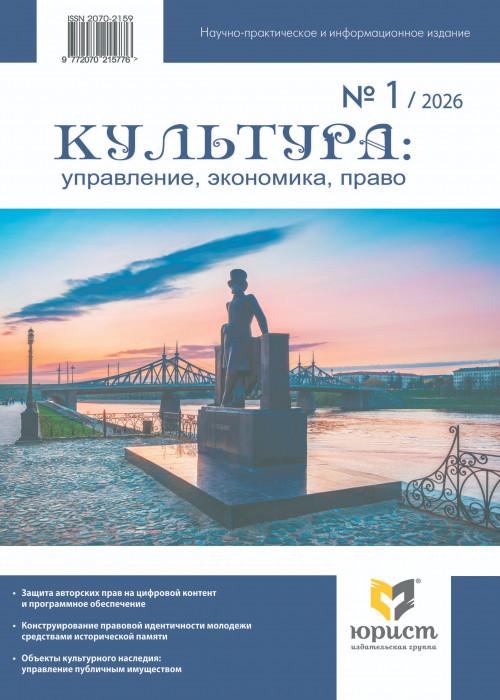
Published Date: 26.03.2026

Constructing the Legal Identity of Youth through Means of Historical Memory

Annotation

The article is devoted to the study of the role of historical memory in the formation of the law identity of young generation. Based on a comprehensive analysis of Russian legislation, the author proves that in the process of formation of the law identity of young generation, a major role is played by historical memory, explicated in memorial legislation, which has an ambivalent nature. On the one hand, memorial laws act as a conventional result of social reflection of the past, which is formalized by the legitimate state. On the other hand, the state, with the help of memorial legislation, constructs frames of historical memory, which are then transmitted to the neophyte in order to determine the main forms of his actions in the process of preserving, interpreting and representing the official historical narrative. Thanks to the use of the latter in law socialization, not only a certain image of the past is transmitted to the younger generation, but also important moral norms, values and models of social behavior. Mastering the official historical narrative is the most important element of the law identity of neophytes, allowing the individual to adapt to the civil nation in terms of value and functionality.


Library

1. Дорская А.А. Официальная политика памяти: сравнительный анализ законодательства и судебной практики современных государств / А.А. Дорская, Д.А. Пашенцев // Журнал зарубежного законодательства и сравнительного правоведения. 2021. Т. 17. № 6. С. 5–15. DOI:
2. Зверев К.А. Политика памяти в Прибалтике и на Украине: общие тенденции / К.А. Зверев // Проблемы национальной стратегии. 2022. № 3 (72). С. 183–198. DOI: 10.52311/2079-3359_2022_3_183
3. Кирносов И.Д. Анализ позиций Конституционного Суда РФ по вопросам защиты исторической памяти / И.Д. Кирносов // Известия Саратовского университета. Новая серия. Серия: Экономика. Управление. Право. 2025. Т. 25. № 1. С. 87–99. DOI: 10.18500/1994-2540-2025-
4. Кольцов П.М. Гражданская религия как фактор идентичности / П.М. Кольцов, С.А. Умгаев, М.В. Надбитов // Каспийский регион: политика, экономика, культура. 2024. № 4 (81). С. 211–219. DOI: 10.54398/1818-510Х.2024.81.4.020
5. Резников Е.В. Понятие правовой идентичности / Е.В. Резников // Право и современные государства. 2014. № 1. С. 9–14. DOI: 10.14420/ru.2014.1.2
6. Araújo, A.L. Introduction / A.L. Araújo // Politics of Memory: Making Slavery Visible in the Public Space / ed. by A.L. Araújo. New York : Routledge, 2012. P. 1–11.
7. Bailleux, A. Droit, histoire et vérité. Oscillations contemporaines / A. Bailleux // Droit et société. 2025. Vol. 119. Iss. 1. P. 9–20. DOI: 10.3917/drs1.119.0009
8. Cedeño Cevallos, C.A. El rol de la memoria histórica en la búsqueda de la verdad como sustancia primordial de la Justicia Transicional: Desafíos epistemológicos y reflexiones ontológicas / C.A. Cedeño Cevallos // Multiverso journal. 2025. Vol. 5. Iss. 8.
9. Fronza, E. Memory and Punishment: Historical Denialism, Free Speech and the Limits of Criminal Law / E. Fronza. Dordrecht : T.M.C. Asser Press, Springer, 2018. 217 p.
10. Guarino, G. Intelligenza artificiale generativa e memoria storica: la problematica del revisionismo tra condiscendenza e allucinazioni / G. Guarino // Futuri. 2025. Vol. 23. P. 251–264.
11. Lamlih, I. La communication intergénérationnelle: dialogue des âges et construction d’un lien durable / I. Lamlih // Revue Marocaine de publucation des recherches scientifiques. 2025. Iss. 2. P. 351–364.

Other articles